Azerbaijan: The Land of Fire Between East and West
Published
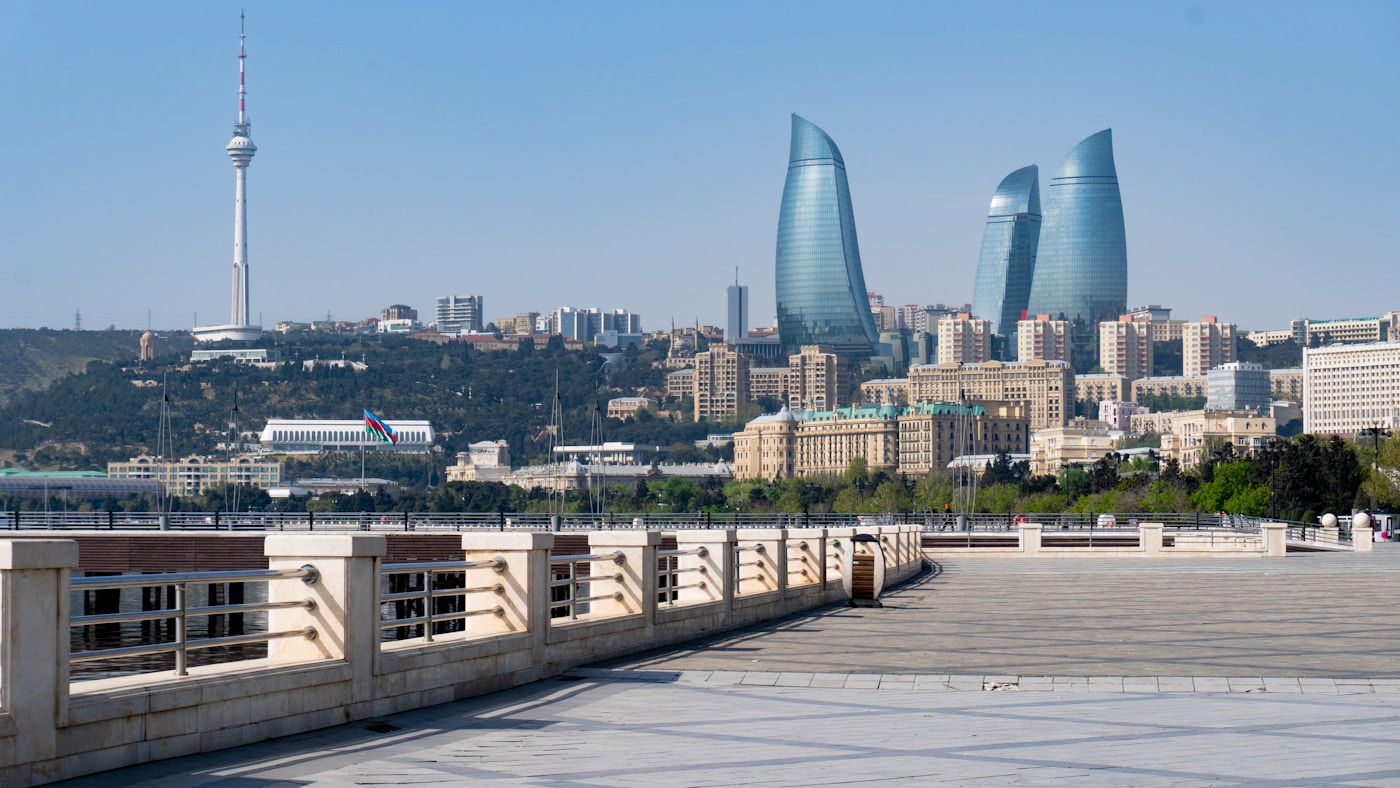
Straddling the ancient Silk Road between Europe and Asia, Azerbaijan captivates with its eternal flames at Yanar Dag, the ultramodern skyline of Baku, and the haunting mud volcanoes of Gobustan — a country where petroglyphs share a landscape with Formula One circuits.
Few countries in the world pack as many contradictions into one territory as Azerbaijan. Here, futuristic glass towers called the Flame Towers rise above a medieval city of caravanserais and bathhouses. The Caspian Sea — technically the world's largest lake — laps at shores where oil rigs have pumped since 1846. Sacred fire temples venerated for millennia stand within sight of Formula One racing circuits. Azerbaijan is, in the most literal sense, a land of fire — and everything else.
Baku, the capital, is the country's astonishing centrepiece. Situated on the Absheron Peninsula where the Caspian meets the ancient Silk Road, Baku has been described as the "Paris of the East." The narrow lanes of the Inner City (Icheri Sheher) — a UNESCO World Heritage Site — conceal 12th-century mosques, the mysterious Maiden Tower (Qız Qalası), whose original purpose nobody is certain of, and the Palace of the Shirvanshahs, one of the finest examples of medieval Azerbaijani architecture.
Beyond the old walls, modern Baku is an exercise in ambition on a spectacular scale. The Heydar Aliyev Centre, designed by Zaha Hadid, is a flowing white building of curves and swoops that seems to have landed from another century. And the Flame Towers — three skyscrapers sheathed in thousands of LED panels — pulse with fire and water patterns after dark, visible from across the city.
Beyond Baku, Azerbaijan reveals more layers. The Gobustan National Park holds some of the world's finest petroglyphs: drawings of animals, boats, and hunters etched into rock by people who lived here 5,000 to 40,000 years ago. Gobustan also hosts the planet's largest concentration of mud volcanoes — more than 300 — that bubble slowly and sometimes erupt in dramatic slow-motion blasts of grey mud. They feel prehistoric, and are.
The Sheki region in northern Azerbaijan is the country's historical and cultural heartland. The 18th-century Sheki Khan's Palace is a jewel of Azerbaijani craftsmanship: its facade is covered with intricate shebeke — stained glass and carved wood lattice — with no glue or nails, purely interlocking patterns of coloured glass and walnut. The interior is frescoed with hunting scenes and geometric patterns in jewel-bright pigments barely faded in two centuries.
The highland village of Khinalug, one of the highest permanently inhabited settlements in the world, the copper craftsmen of Lahij, the pomegranate orchards of Goychay, and the carpet weavers of Baku's bazaars reward the traveller who moves slowly and goes deeper.
Azerbaijani cuisine is a synthesis of Silk Road influences. Plov (saffron-scented pilaf) comes in dozens of regional variations. Dolma wraps spiced lamb in grape leaves, quince, or cabbage. The pomegranate — Azerbaijan's national fruit — appears in sauces, salads, and pressed into juice that glows like dark rubies. Tea, served sweetly in thin pear-shaped glasses, is the quiet ceremony that connects all social encounters.
Arriving in Azerbaijan, you feel that you have reached something genuinely different — a country at the edge of two worlds, carrying thousands of years of Silk Road history and re-imagining itself furiously for the future.
More travel stories